APPLIANCE
REMOVAL
IN ATLANTA
An appliance removal in Atlanta starts with the disconnect, not the dolly: water, power, and drainage get shut off and capped first, then the unit comes out without flooding a floor or gouging a doorway, and gets routed to donation, parts and scrap recycling, or proper disposal — whichever its age and condition actually earn. The full service is on our junk removal in Atlanta page.
Why can’t an old appliance just go out with the regular trash?
Because most routes around metro Atlanta treat a large appliance as a bulky, regulated item, not household trash — and a refrigerator, with refrigerant to recover, is in a category of its own.
I’m Ashton, I run Minty Clean ATL. Old appliances pile up in the same places all over this city. A dead fridge sits in a garage in College Park because the new one is already cold in the kitchen. A washer and dryer wait in a basement in Decatur because nobody wants to carry them up those stairs. A stove leans in a Marietta rental between tenants. None of them are still there because anyone wants them. They’re there because an appliance is hooked up, heavy, and awkward all at once — and getting one out wrong can mean water on a floor or a gas line that needed a licensed hand. Inside the City of Atlanta, a fridge, washer, or stove generally needs the scheduled bulky-waste route, not a spot next to the cart on your normal day, and the rules change by city and county across the metro. Apartment and condo buildings in Midtown, Buckhead, and downtown are stricter: most won’t let a loose appliance sit in a trash room or loading area at all, and many set their own haul-out windows. HOA neighborhoods in places like Smyrna and Johns Creek have the same story in a different form — an appliance on the curb on the wrong day earns a letter, not a pickup. Refrigerators and freezers carry an extra rule everywhere: they hold refrigerant that has to be recovered properly, not vented or landfilled loose. That’s why a fridge can’t just be tipped into any load, and why we’ll tell you plainly how yours will be routed before it leaves.
DISCONNECTED FIRST.
CARRIED CAREFULLY.
ROUTED RIGHT.
The disconnects, in order, and checked dry before anything rolls — power off, water shut off and capped, hoses drained, and a gas line flagged for a licensed cap, never improvised.
The disconnects, in order, and checked dry before anything rolls.
- Refrigerator — power off, the ice-maker water line shut off at its valve and capped, and the line drained so it doesn’t weep across the kitchen floor; food and shelves out, doors taped or strapped shut for the carry, and doors off or secured if the fridge will sit anywhere before pickup
- Washer and dryer — water valves closed, hoses drained into a bucket, power unplugged and the drum given a minute to settle; for a dryer, power or gas confirmed off and the vent disconnected
- The gas line we don’t improvise — a gas connection gets capped by someone licensed to do it; if your stove or dryer is gas and that cap isn’t already handled, we say so before the visit, not with the unit halfway out of its alcove
How does a heavy appliance get out without tearing up the house?
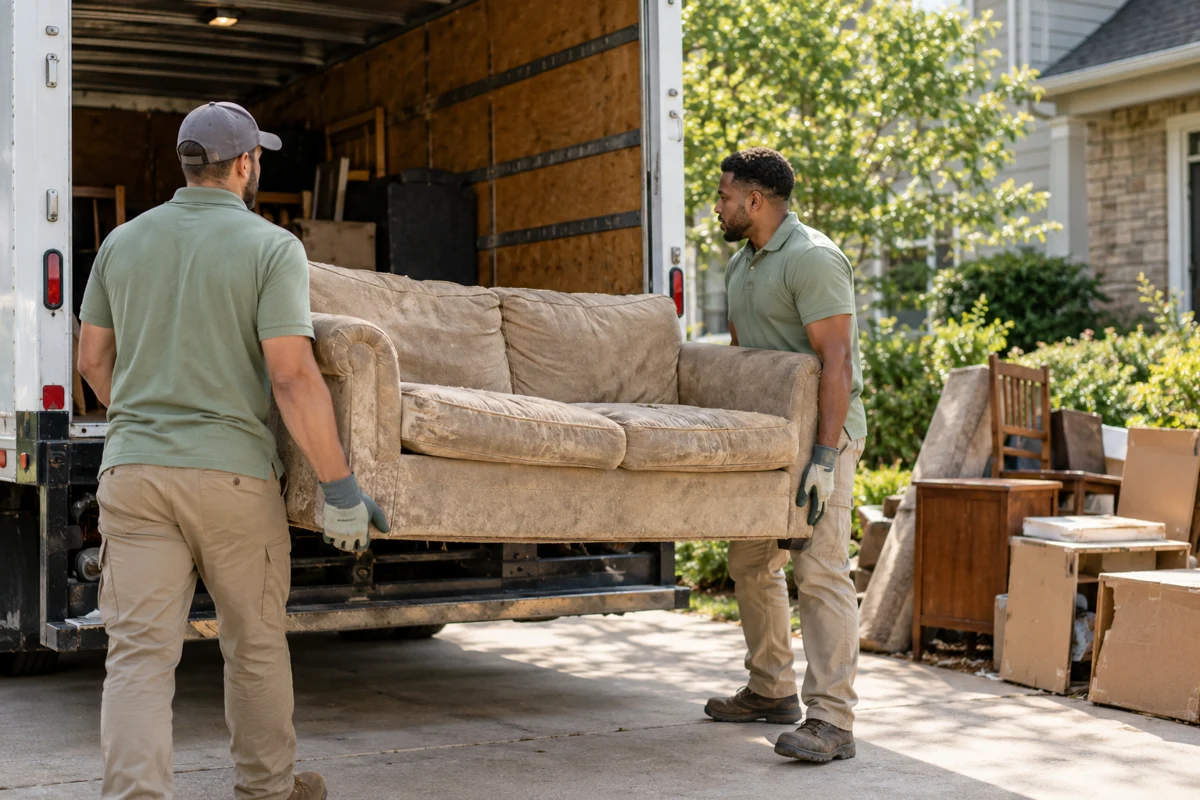
Slowly, on the right equipment, with the route walked first — doorway, hall turn, and stair landing measured, floors protected, and a dolly doing the carrying instead of backs.
A fridge or a stacked laundry pair doesn’t forgive a rushed turn. The path gets measured before the unit moves — doorway, hall turn, stair landing, door swing — because the moment to learn a fridge won’t clear a frame is before it’s leaning in it. Doors come off the appliance or off their hinges when that’s the honest way through; either beats a gouged frame and a scarred floor. Floors get protected on the path, a dolly does the carrying instead of backs, and stairs get planned one flight at a time. Older Atlanta stock makes this its own job: basement laundry rooms in Grant Park and East Atlanta with narrow stairs, kitchen renos in older Inman Park homes with tight back doors, and high-rise moves where the elevator window and loading dock rules are half the work. That’s most of the difference between a removal that takes half an hour and leaves no trace, and one the whole house hears about.
Where does an old appliance actually go?
Where its condition says it should — a working unit can go to donation, a spent one is mostly steel, motors, and copper for recycling, and refrigerant gets recovered on that route.
A working or repairable unit with real life left in it is a donation candidate, and we’ll be straight about whether yours clears that bar. Charities have to be able to place it; a dead compressor in a clean cabinet is still a dead fridge, and hauling it over as a “donation” just moves the disposal problem onto them. A spent unit is mostly steel, plus motors, copper, and wiring that all have a recycling route that isn’t a landfill. That’s the preferred end for most end-of-life appliances. Refrigerant recovery happens on that route for fridges, freezers, and anything with a cooling circuit — handled by the facility equipped for it, which is exactly why the routing matters more than the truck. What’s genuinely left after recovery and parts salvage goes out as proper disposal, and you’ll know which route yours took instead of just watching it leave. Our guide to what happens after a junk pickup explains how loads get sorted.
What about a fridge that’s been sitting closed and full?
It can still be removed, but told up front it stays sealed, doors strapped, and travels sealed — do not open it to check, because that only makes a handled job worse.
Say so when you book, and don’t open it to check. A fridge that lost power with food inside is the one appliance job that gets worse every day it waits, and opening it “to see how bad it is” helps nobody. Told up front, it’s a handled job: the unit stays sealed, doors strapped, and it travels sealed to a route that will accept it in that condition. The same goes for a unit in a garage or basement with any mold or pest question around it. None of it makes the removal impossible. All of it changes how it should be carried, and the time to know is before the crew is standing in front of it — not after.
How do you book an appliance removal, and what does it cost?
Pricing needs a confirmed scope — how many units, what type, whether disconnects are done, and the floor and access all change the work. Call (678) 562-5636.
Pricing needs a confirmed scope — how many units, fridge or laundry or range, whether disconnects are already done, what floor they’re on, and stairs or elevator all change the work, and this page doesn’t give binding prices. Send a photo and tell us the floor and access situation through the quote form at mintycleanatl.com or call (678) 562-5636. We’ll confirm the route — donation, recycling, or disposal — with you, and price and schedule get confirmed before anything is booked. A booking is only confirmed once scope, price, and availability are all confirmed.
Appliance removal FAQs
Do I need to disconnect the appliance myself?
No — and for water lines, please don't start unless you're sure of the valve. Tell us what's hooked up when you book. Power and water disconnects are part of the job as described above; a gas line that needs capping is the one exception, and we'll flag it before the visit so it can be handled by someone licensed.
Can you take a fridge with the food still in it?
Yes, if you tell us up front. It stays sealed, the doors get strapped, and it routes as a sealed unit. What we can't do is sort spoiled food at your curb — bagged food waste you want gone alongside it is a separate, easy add-on when it's booked that way.
Will a charity really take my old washer or fridge?
Sometimes — if it works, it's clean, and it has real life left. We'll give you an honest read from a photo before anyone hauls it across town, because a refused donation costs you the trip and the charity the dock time. If it doesn't clear that bar, the recycling route is a good end, not a failure.
Do the doors have to come off my fridge?
For transport through tight frames, sometimes the appliance doors come off; for any fridge that will sit waiting, the doors come off or get secured shut as a safety rule. Either way it's part of the job, not an extra you have to arrange.
Can you remove appliances from a rental between tenants?
Yes — that's one of the most common versions of this job around Atlanta. Send photos of what's in the unit, tell us the floor and elevator situation, and we'll confirm scope, price, and timing before anything is booked, so the turnover isn't waiting on a garage fridge nobody planned for.
LET’S TALK CLEAN.
Goodbye mess. Hello Minty.Got an old fridge, washer, or stove that needs to go? Send a photo, tell us what’s hooked up and where it sits, and we’ll give you a straight plan for getting it disconnected, out, and routed right. Open 7am to 7pm, seven days a week, across Atlanta and surrounding areas.
Or call (678) 562-5636