HOUSE CLEANING
FOR ALLERGIES
IN ATLANTA.
If someone in your house sneezes more at home than anywhere else, a cleaning built around dust control — damp wiping instead of dry dusting, floors done last and done right, soft surfaces actually vacuumed instead of skipped — will leave the house feeling noticeably easier to be in. It will not cure anybody’s allergies. No cleaning can promise that. What it can do is cut down the dust, pollen, and dander sitting in the house waiting to get kicked back into the air. The full service is on our house cleaning page.
What makes a house hard on allergy sufferers in Atlanta?
Mostly what has settled in it — dust on fan blades and door frames, pet dander worked into rugs and upholstery, and Atlanta pollen that rides in on shoes and clothes and lands on every flat surface.
Atlanta adds its own layer. Pollen season here is not a metaphor — cars go yellow in the spring, and that same pollen rides in on shoes, clothes, and open windows and settles on every flat surface in the house. Add the usual indoor load on top: dust on ceiling fan blades and the tops of door frames, pet dander worked into rugs and upholstery, and whatever is living in a carpet that gets walked on daily but deep-cleaned rarely. None of that is a housekeeping failure. It is just accumulation — and accumulation is what a normal quick clean tends to move around instead of remove. Our pollen season cleaning guide covers the spring surge specifically; this page is about the house that struggles all year.
DAMP WIPE.
DO NOT
DRY DUST.
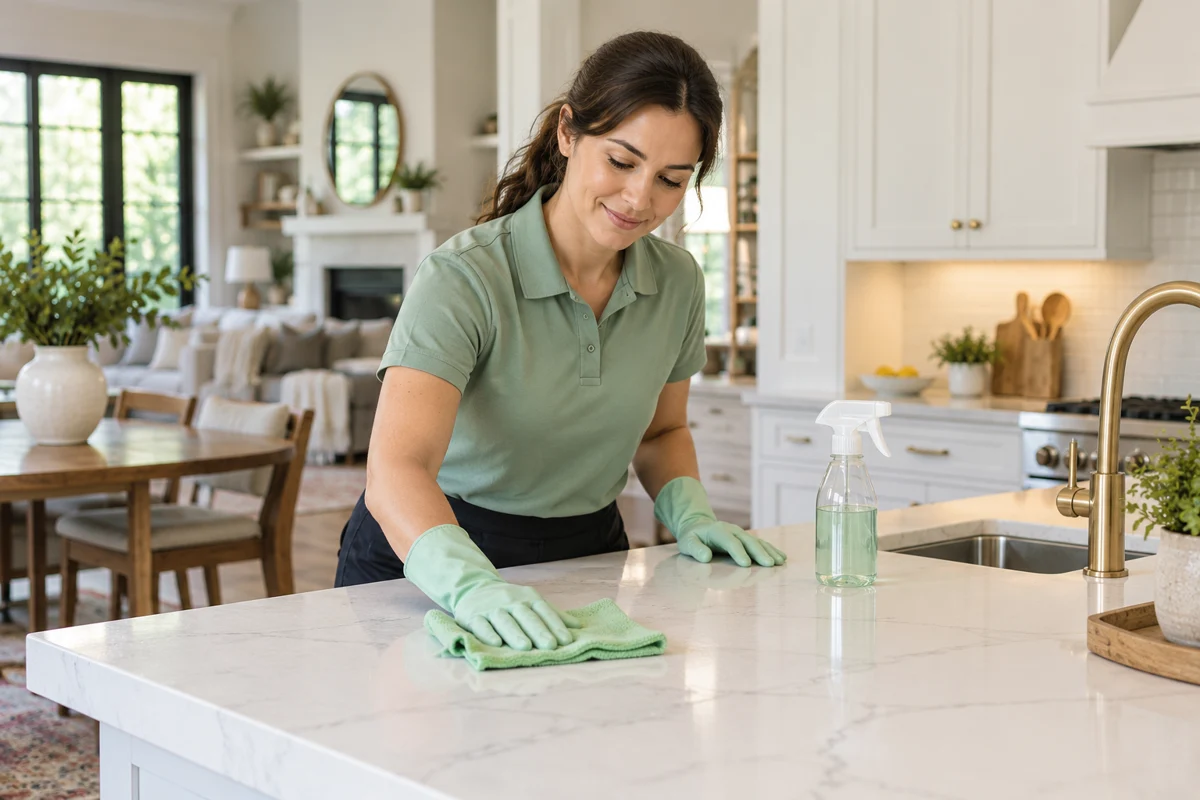
Because a dry cloth or feather duster pushes most of the dust into the air, where it floats and lands somewhere else. The room looks clean; an hour later the dust is back, just redistributed.
Damp wiping is the boring fix that works, and it shapes the whole clean.
- Damp microfiber, not a dry cloth — a slightly damp microfiber cloth actually picks dust up and holds it, instead of launching it off the shelf edge
- Vacuum first, then a damp mop — slow passes on the floors, so you are removing what is there instead of swirling it into the air or across the room
- A few minutes longer per room — that extra time is not padding; on an allergy-focused clean, it is the whole point
What should an allergy-focused clean actually cover?
The places dust and dander live, in top-to-bottom order — fan blades, vents and high surfaces first, damp-wiped surfaces next, soft surfaces vacuumed properly, and floors last so nothing resettles on them.
Top to bottom matters more here than anywhere. Ceiling fan blades, light fixtures, vents and returns, the tops of cabinets and door frames — all of that comes first, because everything that falls still has the floors waiting below it. Then surfaces, damp-wiped. Then soft stuff: couch cushions vacuumed and lifted, rugs vacuumed slowly enough for the machine to do its job, bedding washed hot if the care labels allow it. Bedrooms deserve the most time, not the least — you spend a third of your life with your face in that room. Mattress surfaces, nightstands, the floor under the bed where dust collects undisturbed: that is where an allergy-conscious clean earns its money. Kitchens and bathrooms matter too, mostly for moisture — a bathroom that stays damp grows things nobody needs to breathe.
How often does a house like this need cleaning?
For most Atlanta homes with an allergy sufferer, every two weeks with the dust-control work built in — weekly in peak pollen season, roughly March through May, especially with pets in the house.
Hard surfaces can go a bit between deep passes. Rugs, upholstery, and bedding cannot — they are the reservoirs. A recurring clean every two weeks with the dust-control work built in holds the line better than one heroic deep clean twice a year, and in peak pollen season weekly might be the honest answer for some houses, especially with pets. The deep clean still matters. It is the reset that gets the fan blades, vents, baseboards, and under-bed territory back to zero. The recurring visits are what keep it from climbing right back. What a clean runs depends on scope — our house cleaning cost guide explains what actually moves it.
What can you do between cleans without making it a second job?
Shoes off at the door in pollen season, bedding washed weekly, the bathroom fan run until the mirror fully clears, the HVAC filter changed on its real schedule, and slow vacuum passes between visits.
A few small habits carry most of the weight. Shoes off at the door during pollen season — tracked-in pollen is real, and the entryway rug tells the story. Wash bedding weekly if someone is struggling at night. Run the bathroom fan long enough after showers that the mirror fully clears, and then some. Change the HVAC filter on the schedule the filter actually calls for, not the one you remember; a clogged filter stops catching what the system pulls in. And when you vacuum between visits, go slower than feels natural — fast passes mostly clean the middle of the rug, while the edges and the traffic lanes are where the dander sits.
How is Minty Clean set up for a house like this?
Tell us up front that allergies are the reason for the call — dust control comes first, bedrooms get the most time, soft surfaces are done properly, and products stay simple where you would rather keep them simple.
Tell us about pets, which rooms matter most, and anything you want us to avoid using, and we will build the clean around that instead of running a standard checklist at a house that did not ask for one. Pricing needs a confirmed scope, same as everything we do — size of the place, condition, what is in it, and how often. And if we miss a spot, the Minty 24-Hour Promise stands: tell us within 24 hours and we come back and re-clean it, free.

House cleaning for allergies FAQs
Can a professional cleaning cure allergies?
No. Cleaning reduces the dust, pollen, and dander sitting in a home, and a lot of people find the house easier to live in afterward. It is not a medical treatment, and anyone whose symptoms are severe or getting worse should be talking to a doctor or allergist, not just a cleaning company.
Should I leave the house during the clean?
Some people with strong sensitivities prefer to step out while the work is happening and come back after everything has settled, since even careful cleaning stirs a little dust up front. It's a reasonable call, especially for a first deep clean. For regular recurring visits, most clients stay home without a problem.
Do you bring your own supplies?
Yes, we bring what the job needs. If there are products you'd rather not have used in your house — scents are a common one — say so when you book and we'll plan around it. That conversation is easier before the clean than during it.
What matters more, a deep clean or recurring visits?
Both, in that order. The deep clean clears out what's built up in the vents, fan blades, baseboards, and soft surfaces. Recurring visits keep it from building back. Booking one deep clean a year and nothing between usually leaves the house right back where it started by pollen season.
LET’S TALK CLEAN.
Goodbye mess. Hello Minty.Tell us what is going on in the house and we will build the clean around it — dust control first, bedrooms heavy, soft surfaces done properly. Open 7am to 7pm, seven days a week, across Atlanta and surrounding areas.
Or call (678) 562-5636